
Havering and Wates have signed a pre-construction deal for the first 107 homes on Romford's Waterloo estate, targeting 2028. The full scheme is 1,380 homes and began in 2016.
The first two residential blocks on Romford’s Waterloo estate have moved into their design phase, six months after winning planning approval and more than nine years after the council approved the regeneration programme they belong to. Havering Council and Wates Residential signed a Pre-Construction Services Agreement for Blocks 9 and 10 on 12 August, which allows detailed design work to begin ahead of construction. The blocks are targeted for completion in 2028. (Havering Council, 12 August 2026)
Between them the two blocks will deliver more than 107 affordable homes, a community space and landscaped public areas. That figure comes from the council’s announcement in March, when planning permission was granted on 26 February 2026 through a combined Section 73 application, which updated the planning conditions attached to the original masterplan, and a Reserved Matters application setting the detailed designs. (Havering Council, 3 March 2026)
107 homes out of 1,380
Blocks 9 and 10 are the first phase of a much larger scheme. The Waterloo estate is the biggest of the twelve sites in Havering’s regeneration programme, and the council’s plan for it is 1,380 new homes including three and four bedroom family houses, plus commercial workspace, play space, a raingarden and what the council calls a community village green. (Havering Council, Waterloo and Queen Street)
So the agreement signed last week covers under 8 per cent of the homes the site is eventually meant to hold. The council’s own project page sets out the wider benefits it expects from the Waterloo scheme: 121 new jobs for local people, 6,474 apprenticeship training weeks on site, 50 adult work experience placements, and an estimated 209 Havering residents working on the site.
Across all twelve sites, the council says the programme will double the amount of affordable housing on those estates, increase council rented homes by 70 per cent, and create just under 400 shared ownership homes. Every council tenant who moved out to enable the works is guaranteed the right to return to a new property. (Havering Council, 12 Sites Regeneration Programme)
One figure does not match between the two council sources. Last week’s announcement describes the joint venture as “a £1 billion scheme delivering over 3,000 new homes across the borough”, while the programme’s own page says the partnership will deliver “over 3,500 much-needed new homes”. Both pages were live on the council’s site on 15 August 2026 and neither is dated as superseding the other.
The scheme was paused in 2023
Councillor Robert Whitton, Cabinet Member for Regeneration, said the agreement “marks an important leap forward in the regeneration of Waterloo and Queen Street, which has been stalled under previous administrations.”
The council’s own published record for the site supports the point about a stoppage, and dates it. Its project timeline lists two newsletters issued in May 2023: one to residents with the right to return, and one to Cotleigh Road residents and London Road businesses, both “about the pause to the scheme”. Nothing on that timeline records the pause being lifted; instead the entries resume in 2025 with a separate project, when Cabinet approved temporary modular homes in January 2025, permission for the pilot modular scheme was granted in May 2025, and the contract was awarded that October.
Work on the blocks themselves restarted publicly in July 2025 with a consultation on 29 July, a final consultation in August 2025, and the planning submission in October 2025.
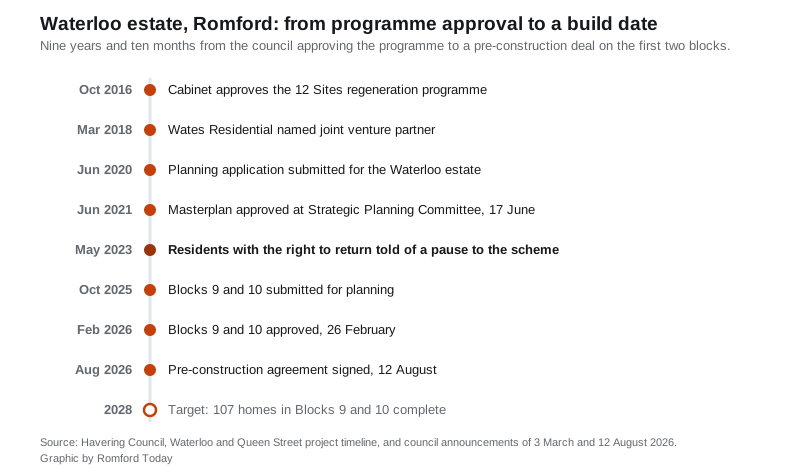
The full sequence runs a long way back. Havering’s Cabinet approved the twelve sites programme in October 2016, Wates Residential was named as joint venture partner in March 2018, the planning application for the Waterloo estate was submitted in June 2020, demolition started in May 2021, and the masterplan was approved at the council’s Strategic Planning Committee on 17 June 2021.
It is also worth noting that the February approval was announced under a different council leader. That release carried a quote from Councillor Ray Morgon as Leader of Havering Council; last week’s releases name Councillor Keith Prince AM in the role.
What has not been confirmed
The council has not published the tenure split within the 107 homes, so it is not yet clear how many will be council rented and how many shared ownership. Nor has it given a construction start date, only the 2028 completion target. The March announcement put that target at “late 2028”; last week’s put it at “2028”.
The council’s project page for Waterloo and Queen Street had not been updated at the time of writing and still states that the scheme is “currently at the planning stage for Blocks 9 and 10”, which the February permission superseded. Havering’s online planning register was returning a 502 error when we tried to pull the decision notice directly, so the application reference is not quoted here.
What it means for you
If you are a former Waterloo or Queen Street resident holding a right to return, this is the first hard date attached to homes you could actually move into, and it is 2028 at the earliest. Nothing signed last week changes the guarantee itself, which the council restates on its programme page.
If you live near the site, on Cotleigh Road or along London Road, the practical consequence is that design work starts now and construction traffic follows it rather than arriving imminently. The council has not said when hoardings and site works begin.
For everyone else in Romford, the number to hold onto is the gap between 107 and 1,380. This is the first phase of a scheme that has been running since 2016, and on the council’s own published dates it took just over five years to get from masterplan approval to a pre-construction agreement on the first two blocks. Judge future announcements against that.
Queries about the project go to regeneration@havering.gov.uk, the address the council gives on the scheme page. For planning decisions across the borough, see our Romford planning news, and for what new supply is doing to values locally, our Romford house prices page.
Have your say