

From 31 October Havering councillors can no longer call a planning application in to committee. One five-seat committee replaces two, and a two-person Gateway decides what it hears.
Havering councillors lose the right to call a planning application in to committee on 31 October. From that date, a councillor who wants a public committee to decide a scheme can only ask for it to be considered. Two people then decide whether it goes: the council’s Assistant Director of Planning and the chair of the planning committee.
The change comes from national law, not a local choice. Full Council voted through the new rules on 2 September, and the council announced them on 15 September (Havering Council, 15 September 2026).
What changes on 31 October
The government’s new planning regulations take effect that day across England (SI 2026/854, legislation.gov.uk). Havering’s report to its Governance Committee on 19 August sets out what they mean here (Havering Council, Governance Committee report, 19 August 2026).
- Two committees become one. The Planning Committee and the Strategic Planning Committee, five councillors each, are abolished. A single new Planning Committee replaces them.
- Some applications can never go to committee. Householder extensions, minor commercial schemes and small housing schemes must be decided by officers. The law gives councillors no role in them.
- Everything else goes to officers too, unless it passes a “Gateway Test”. The Assistant Director of Planning and the committee chair must both agree that an application raises an issue of significance to the local area, or a significant planning matter.
- Call-in becomes a “Gateway Request”. A ward councillor, or one from an adjoining ward, must ask in writing within 21 days of the application appearing on the weekly list. The request must set out the issues and say whether anyone has approached the councillor about the application.
The council’s own briefing paper puts the first point plainly: “there will no longer be a general right for Members to call-in applications for committee consideration” (Havering Council, planning committee briefing, August 2026).
Five seats, not nine
The officers’ report proposed nine members for the new committee. The law allows up to 13. The report said nine would leave enough time to deliberate on each application.
The Governance Committee instead recommended five (Havering Council, report to Full Council, 2 September 2026). Full Council agreed the five-member committee by 39 votes to 10, with four abstentions. The wider constitution changes passed by 48 votes to 3 (Havering Council, decisions of Council, 2 September 2026).
That means ten committee seats across two committees become five. Councillor Kevin Ayres was elected chair of the new committee, by 41 votes to 12. Councillor Sathya Maddasani was elected vice-chair, by 40 votes to 13. Under the new rules the chair, or normally the vice-chair as stand-in, is the councillor who sits on the Gateway.
How many applications this touches
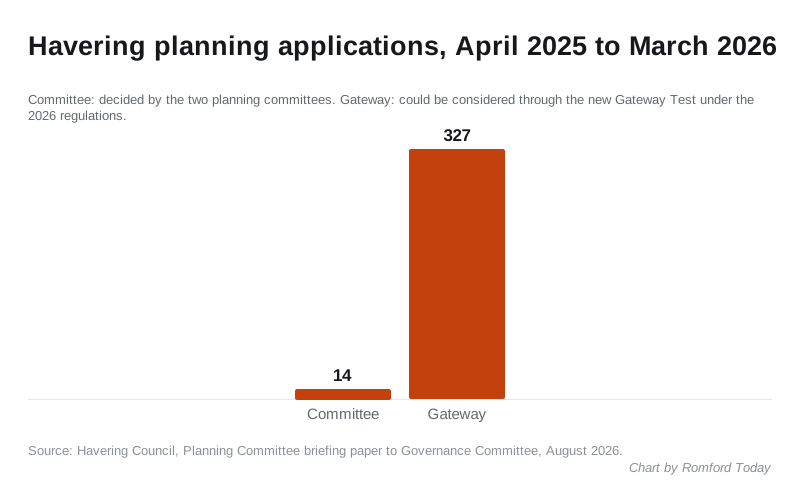
Very few applications reached a committee even before the change. Havering’s briefing paper counted 14 applications decided by the two committees between April 2025 and March 2026.
The same paper says 327 applications in that year could have been considered through the Gateway under the new law. The council called putting “circa 300+” through the test a “significant administrative burden”. So its new rules limit which applications go to the Gateway at all.
Only these reach the Gateway, under the new Planning Committee Procedure Rules (Havering Council, Planning Committee Procedure Rules, August 2026):
- schemes that must be referred to the Mayor of London
- applications a ward councillor has asked to go through the Gateway
- applications to change conditions on a permission the committee granted
- listed building consent linked to one of the above
- applications the Head of Development Management thinks raise significant policy issues
- council schemes classed as major development, and applications from councillors or senior council officers
Everything else is decided by officers.
The last call-ins, on Thursday
The Strategic Planning Committee meets on 1 October under the old rules. Both applications on its agenda are there because of a councillor call-in (Havering Council, Strategic Planning Committee, 1 October 2026).
Both concern the Verve Apartments in Mercury Gardens, Romford. The owners want to cut the parking on the land south of the block from 60 general spaces to 18, including five disabled bays. That would leave 45 spaces across the whole site. Officers recommend approval (Havering Council, committee report P0904.25).
After 31 October, a call-in like that would not put an application on a committee agenda by itself. The ward councillor could only ask for a Gateway Test, and the two Gateway members would decide.
What the leader said
Council leader Keith Prince AM said Havering must update its rules so its decisions “remain lawful and robust”. He added: “I am concerned that the Government’s reforms will reduce the role of elected Councillors in the planning process.”
The council says committee decisions taken where the law requires an officer decision “may be vulnerable to legal challenge” from 31 October. That is why the constitution had to change before then.
What it means for you
- You can still comment on any application. The rules keep the usual window, normally 21 days, for anyone to send written comments to the planning service. Use the online comment form or planning@havering.gov.uk. The rules warn that a case officer’s own inbox may not be monitored, and councillors must pass on any comments sent to them.
- Contact your ward councillor early. A councillor now has 21 days from the weekly list to ask for a Gateway Test. After that, the route to a committee closes.
- Public speaking at committee stays. One registered objector can speak for up to five minutes on each application, with the applicant allowed to reply.
- The rules do not say whether Gateway meetings will be held in public, or how their decisions will be published. We have not found either in the papers, and will report it when the council sets it out.
Weekly lists and how to comment are on our Romford planning news page. We covered the last big committee decision in our Como Street car park story.
Have your say