
Havering wants to stop using hotels and nightly paid rooms for homeless households by 2030. On 31 March, 1,320 households were in temporary accommodation.
Updated 16 November: Cabinet approved and adopted the strategy on 11 November, according to the published decision. It takes effect on 19 November unless it is called in by the 18 November deadline.
Havering Council has set itself until 2030 to stop placing homeless households in hotels and nightly paid rooms. The target is the centrepiece of its new homelessness strategy, which Cabinet adopted on Wednesday 11 November.
The council says it has had more than 15,000 approaches from households facing homelessness in the last five years. On 31 March 2026 it had 1,320 households in temporary accommodation, including 1,863 children, according to government homelessness figures.
Cabinet adopted the Homelessness Prevention and Rough Sleeping Strategy 2026 to 2029. It also agreed that progress will be reported every year through the council’s scrutiny arrangements.
The four aims
The Cabinet report sets out four objectives:
- prevent and reduce rough sleeping, including people caught up in exploitation and begging
- end the use of nightly paid and hotel accommodation by 2030
- give a better experience to households who do end up in temporary accommodation
- provide “compassionate, empathetic customer care that listens and takes action”
The report says the strategy does not commit the council to any new spending. Schemes that need extra money will come back for separate approval.
Why the council is relying on hotels
The strategy document describes “a collapse of the ordinary private rented market for homeless households” in the borough. It blames landlords leaving the market, rents rising faster than housing benefit, and letting agents turning away tenants on benefits.
Its sharpest figure is the loss of private sector leased homes. These are flats the council rents from landlords to house homeless families. The strategy says the number has fallen from around 800 to about 400.
It also gives the cost. An average placement costs the council about £83 a night. The aim is to bring that towards about £41 a night, roughly the level housing benefit covers, “where supply and subsidy conditions allow”.
Relationship breakdown is still the most common reason people become homeless in Havering, the report says.
What the council plans instead
The strategy lists what is already in place or on the way:
- Jubilee Court (71 units) and a Family Welcome Centre (74 units)
- 18 modular homes, described as the first phase
- a build-to-rent deal through the Inspired Solutions partnership of up to 600 homes at rents linked to housing benefit, for 40 years
- buying homes through QLM, a community interest company linked to the council
- expanding Housing First, which gives people with complex needs a home with support, from 20 places to up to 40
The council’s own delivery framework, last updated on 25 September, shows the scale of the task. It rates the plan for a quarterly reduction in temporary accommodation as red, and hotel placements as red. It marks the number of households in temporary accommodation as “worsening”. The replacement for the lost leased homes is also rated red, at 20% complete.
How many households are in temporary accommodation
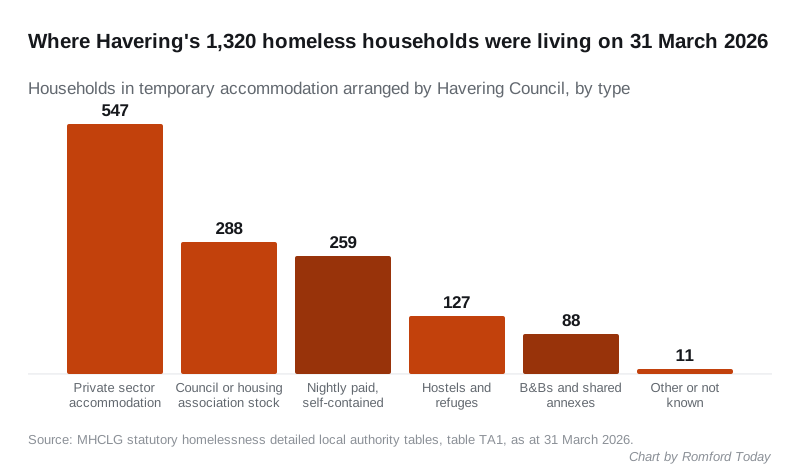
The government’s table TA1 shows where Havering’s 1,320 households were living on 31 March 2026.
| 31 March 2025 | 31 December 2025 | 31 March 2026 | |
|---|---|---|---|
| Households in temporary accommodation | 1,334 | 1,307 | 1,320 |
| Households in B&Bs | 94 | 72 | 88 |
The total has barely moved in a year. Havering had 12.6 households in temporary accommodation per 1,000 households, against 21.1 across London and 5.5 in England.
Of the 88 households in B&Bs, 31 had children. Eleven of those families had been there for more than six weeks. The law says B&Bs are not suitable for families, except where nothing else is available and then for no more than six weeks in total.
A further 259 households were in nightly paid, self-contained accommodation. That is the other type of placement the strategy wants to end.
Rough sleeping
The strategy says the number of people sleeping on Havering’s streets has been “often in single digits” for the past five or six years. It says the council met its earlier goal of ending long-term rough sleeping by 2022, with help from Ahava Community, formerly Hope 4 Havering, and the Salvation Army.
It warns that “street presence and street begging do not always equate to street homelessness”. Some people who appear to be sleeping rough have somewhere to live but are being exploited or controlled by others, it says.
What it means for you
If you are worried about losing your home, contact the council’s housing team as early as you can. Councils have a legal duty to help eligible households who are threatened with homelessness within 56 days. The strategy says early prevention is where it wants to focus.
If you are already in temporary accommodation, the strategy promises clearer information, reviews of long stays and a feedback route for children and families.
A progress report is due to the council’s overview and scrutiny members within 12 months of the strategy being adopted.
Have your say