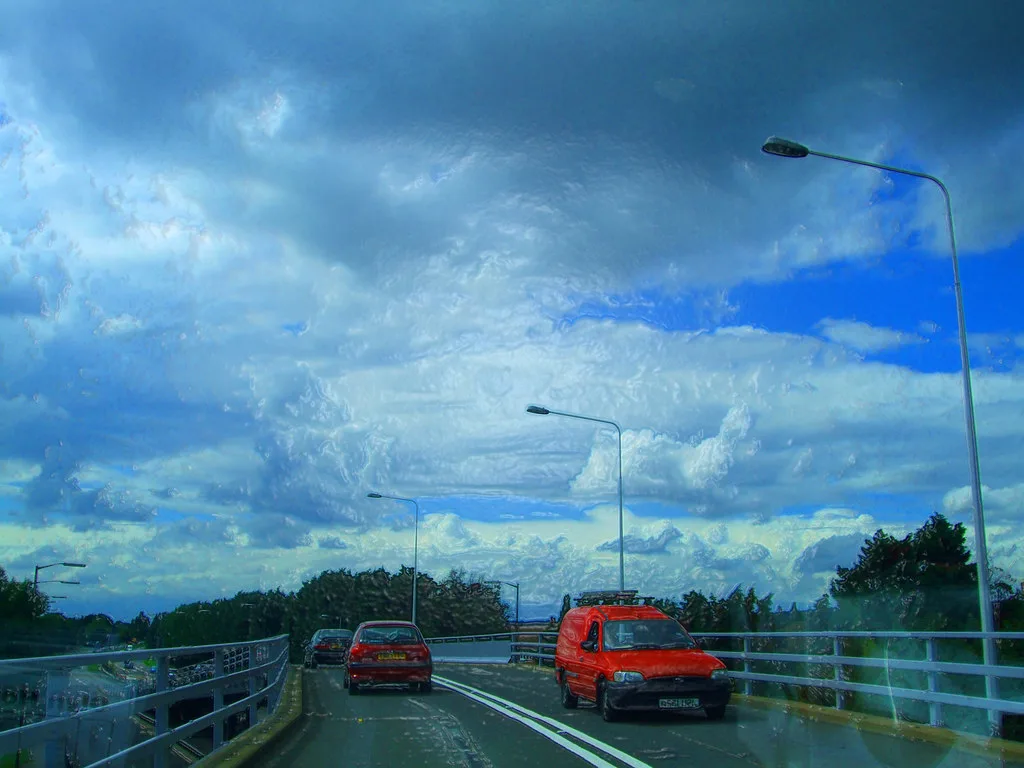

Gallows Corner is open in every direction and the diversions are gone. TfL confirmed it on Monday, a year after its own published programme said it would.
Gallows Corner is open. Every arm, the roundabout and the flyover, with the diversion signs taken down.
Transport for London confirmed it on Monday 21 September. “Gallows Corner flyover has fully reopened to all traffic,” its statement says, and “all remaining traffic management and diversion routes have been removed” (TfL, 21 September 2026).
Two other things confirm it rather than announce it. TfL’s travel advice page for the works, which for eighteen months ran to several screens of closures and diversions, is now one sentence long. And the live disruption record for the junction, which had sat on TfL’s A12 feed since the works began, has gone from it. Checked this morning, the only entry on that feed for the whole of the A12 in Havering is an unrelated slip road closure at the M25 (TfL Unified API, A12 disruption feed).
A year later than the programme said
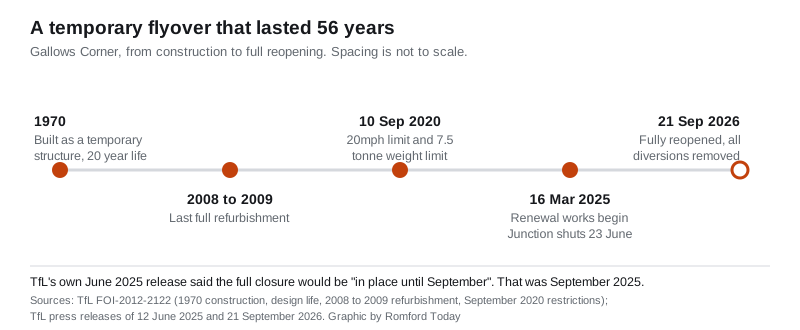
When TfL announced the full closure of the junction, it was specific about how long it would last. The second phase began at 21:00 on 23 June 2025, and the release that set it out said “the closures will be in place until September” (TfL, 12 June 2025). That was September 2025. The same release dated the first phase of the project to 16 March 2025.
The junction reopened in September 2026 instead.
What went in between is on the record. The flyover itself went well, and its final span came out in early August 2025. The water main did not. “Unforeseen problems with the condition of the ground around the water main have unfortunately delayed that part of the works,” the Mayor of London told the London Assembly, “and this in turn has affected the overall timeline.” That was his answer to a question from Keith Prince, now the Leader of Havering Council, in September 2025 (Mayor’s answer to question 2025/3095, 19 September 2025). The eastbound flyover came back on 10 May 2026, the water company handed the site over on 31 August, and one final weekend closure put the surface, the markings and the street furniture back.
The restrictions have not come off yet
This is the part worth reading carefully, because it is the bit that changes what you can drive over the flyover.
Since 00:01 on 10 September 2020 the flyover has carried a 20mph speed limit and a 7.5-tonne weight restriction. TfL imposed both after structural assessments of a structure built in 1970 as a temporary one. The same TfL record lists what kept it in service afterwards: monthly bolt checks, quarterly bolt re-tightening, six monthly structural assessment surveys and repeated parapet and expansion joint replacements (TfL, FOI-2012-2122, published 10 January 2022).
Monday’s statement does not say those restrictions are gone. It says the new structure “will enable the removal of speed and weight restrictions”. That is the same future tense TfL has used since February 2025, and it has not named a date for the signs changing. Until it does, treat the flyover as a 20mph, 7.5-tonne road, whatever the traffic around you is doing.
Neither TfL’s statement nor its travel advice page says when the signs change. We will update this page when it does.
What was actually replaced
The original flyover was built in 1970 as a temporary structure with a twenty year lifespan. It is thirteen simply supported steel and concrete spans of about 18 metres each, sitting on steel trestles, designed by Braithwaite & Co for quick erection and dismantling, and it was last fully refurbished in 2008 and 2009. All of those details come from the same TfL response.
Everything above the foundations has now been renewed. Alongside it, TfL says the scheme has delivered:
- new pedestrian and cycle crossings around the roundabout
- resurfacing and improved road markings across the site
- a structure it expects to serve “for decades to come”
Costain did the strengthening, refurbishment and resurfacing. Essex and Suffolk Water diverted and replaced a water main and distribution mains under the junction at the same time, which is why the two programmes were tied together and why one delayed the other.
There is one number TfL has not published: what it cost. What is on the record comes from the Mayor’s answer to the Assembly in July 2024 (question 2024/1555):
- the Department for Transport approved TfL’s outline business case and committed to fund 85 per cent of the estimated cost through its Major Road Network programme
- TfL covers the other 15 per cent from its business plan
- £57.3 million had been earmarked for the scheme at that point
- TfL had already spent about £3.5 million of its own money on design and planning
Monday’s release gives no outturn figure.
The apology, and the compensation question
TfL’s Chief Capital Officer, Stuart Harvey, went further than TfL has before:
We’d like to apologise to local residents, businesses and road users for the delays to these works and thank them for their patience while this essential project has been carried out.
That leaves the money question where it was. Havering Council’s Leader, Councillor Keith Prince AM, set out his position on 10 September. He said he would “keep pressing TfL for compensation for businesses affected, and for the Council, whose roads have been impacted and damaged by larger vehicles being forced onto diversion routes that are not appropriate for their weight or size” (Havering Council, 10 September 2026).
Around 2,000 residents petitioned last year for council tax refunds covering the overrun. The council has said it has no legal power to rebate council tax. TfL’s reopening statement does not mention compensation at all.
Councillor Prince had set the end of October as his deadline for the junction being fully open. It beat that by more than five weeks.
What it means for you
- Drive it normally again. No diversions, no signed alternative routes, no weekend closures booked. If a journey planner still routes you round Gallows Corner, it is using old data.
- The flyover is still 20mph and 7.5 tonnes until TfL says otherwise. Lorry operators in particular should not assume the weight restriction has lifted because the cones have gone.
- Buses through the junction run their normal route. TfL’s travel advice page had been warning of delays of around 3 to 5 minutes on routes 174, 496, 498 and 499; the traffic management causing them has gone.
- The pressure roads get their capacity back. Ardleigh Green Road, Gubbins Lane, Gooshays Drive and the A118 through the town centre took the diverted traffic for most of eighteen months.
- Watch for the collision record. In the forty years to August 2021 TfL logged 721 personal injury collisions within 200 metres of the junction centre, three of them fatal, 69 serious and 649 slight. New crossings and new markings are part of what the scheme was meant to change, and it is a number worth checking again in a year.
Our Romford roadworks and travel page carries what is closed in the borough this week, and the train times page has the c2c and Elizabeth line position.
Sources
- TfL: Gallows Corner flyover fully reopens to traffic following major refurbishment work, 21 September 2026 (the reopening, the removal of traffic management, what was replaced, the Stuart Harvey quote)
- TfL: Gallows Corner flyover works travel advice page and the TfL Unified API A12 disruption feed, both checked 22 September 2026
- TfL: Gallows Corner junction to close from 23 June until September, 12 June 2025 (the original programme and the 16 March 2025 start)
- TfL: Construction work to start on major project to refurbish Gallows Corner flyover, 28 February 2025 (the phasing and the restriction removal wording)
- TfL FOI-2012-2122, published 10 January 2022 (1970 construction and twenty year design life, the thirteen spans, the 2008 to 2009 refurbishment, the September 2020 20mph and 7.5-tonne restrictions, the collision record)
- Mayor of London’s answers to the London Assembly: question 2024/1555, 5 July 2024 (the funding split and the £57.3 million) and question 2025/3095, 19 September 2025 (the water main ground conditions and the delay)
- Havering Council: “Nightmare almost over” as Gallows Corner final works begin, 10 September 2026 (the Leader’s compensation position and the October deadline)
Have your say